This post was adapted from a piece originally published September 16, 2017, by PC Bushi at the Castalia House blog.
As we approach the Christmas season, I thought it might be appropriate to rap a little about keeping focus on Christ, albeit in a different context:
One day about a decade ago, I was leafing through my Treasury of Fantasy (I love me some shortish SFF) and pondering what to read next. Phantastes, perhaps, or the King of Elfland’s Daughter? I was hungering for something a bit leaner, and given that it had been quite some time since I had partaken of anything Arthurian, I decided to have a taste of “the Quest of the Holy Graal,” by Mrs. Andrew Lang.
So far as I can tell, this is a piece from Andrew Lang’s Book of Romance (1902). I know his wife worked with him on some of his Fairy Books, so perhaps she had a hand in this one, as well, despite not being credited in the original volume. At any rate, the story tells a version of the famous quest of the Knights of the Round Table, and is broken up into several sections following a few of the more prominent heroes.
There are interesting differences in this manifestation when you think of some of the more popular and recent tellings of the Grail story. If you’ve seen the 1981 masterpiece Excalibur, you may as I did associate the quest for the Grail with the sickening of Arthur and the land, and their restoration. Here, a vision of the Grail appears to the knights and they are temporarily stricken dumb. Then Gawaine swears a quest to seek it out, and many of the other knights declare likewise. Arthur is displeased, lamenting the fellowship of the Round Table to be broken and knowing that many of his knights would not return.
Additionally, and critically, there is the element of Christian faith. It is not only prominent, but integral to the tale. Jeffro has talked about the creeping dominance of secular SFF and its inferiority to Christian fantasy. The legends of King Arthur and his knights perfectly illustrate this point.
I couldn’t put my finger on it at the time of its release, but part of the reason King Arthur: Legend of the Sword looked so off to me was its overt secularity. I don’t mean to say that you can’t have an adventure story that doesn’t mention Christ, but without his faith, the stories of Arthur are quite simply soulless. It’s essential to who he and his knights are! Without it, the magic and the wonder are lessened. Removing Christian faith from Arthurian lore is like removing robots from the Terminator series!
A few examples of some wondrous stories from Lang’s “Quest of the Holy Graal,” then.
One of the first tales follows the quest of Sir Galahad. After acquiring a magical shield that can be born only by the worthiest knight in the world, some monks ask for his assistance in driving off a “fiend” that has been haunting their churchyard. He approaches the tomb from which maddening cries are issued both night and day, and a voice bids him stop.
“Lift up the stone,” said a monk, and Galahad lifted it, and a voice cried, “Come thou not nigh me, Sir Galadhad, for thou shalt make me go again where I have been so long.”
Galahad ignores this and lifts the stone all the way up. The fiend speaks again.
“Galahad,” said the figure, “I see about thee so many angels that my power dare not touch thee.”
The knight and the brothers then proceed to remove the body from the churchyard, having been protected from the wight’s power by Galahad’s faith and goodness.
Another episode tells of a supernatural encounter had by Sir Percivale, who has been left horseless and thus fallen behind his comrades. A knight rides past him on the road, and a yeoman shortly after riding a pony. The yeoman asks if Percivale had seen a knight on a horse, for he had just been robbed of the one belonging to his lord. Percivale answers in the affirmative and tells the yeoman that he would pursue the thief if he were mounted. And so the yeoman gives over his pony and asks the hero to recover his horse.
Percivale catches up to the knight and hails him, but the knave simply turns and spears the pony and rides off. That eve at midnight, a strange woman appears suddenly and offers him her own horse if he promises to grant her a favor when called upon. He accepts and is amazed at the ungodly speed of the beast, which traverses the length of four days journey in an hour. Percivale stops the beast as it is about to cross a great, violent river. After sizing up the water he decides to pass, but first he crosses himself upon his forehead. At this, the thing in the shape of a horse lets loose a sorrowful cry, shakes him off, and flies across the river. Percivale realizes that he had been riding a demon that would have destroyed him, and so he gives thanks and spends the rest of the night praying before continuing his adventure.
The rest of the stories follow in similar fashion and are filled with mysterious figures of both divine and unholy natures. Many of the obstacles and enemies are of a spiritual nature and not simply flesh-and-blood opponents to be overcome in battle.
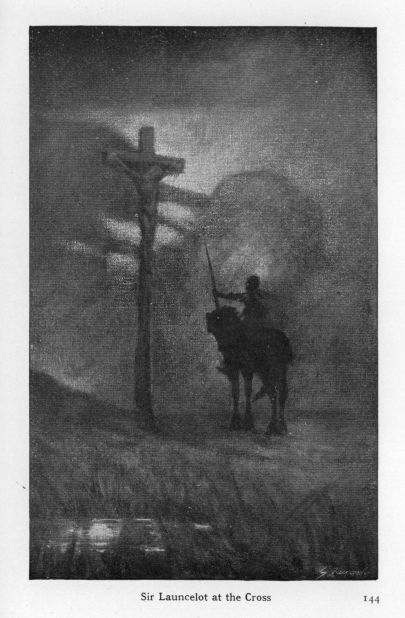
Lancelot is always a somewhat tragic figure, but I was surprised at how harshly he is treated in some of these stories. At the end of one failed adventure he is told:
“Now that I have warned you of your vainglory and your pride, beware of everlasting pain, for of all earthly Knights I have pity of you, for I know well that among earthly sinful Knights you are without peer.”
Even in Excalibur, which is mindful of the Christian nature of Arthur’s legend, Lancelot is portrayed as near-perfect, with the sole sin being his lust for the Queen and betrayal of his King. Nearer to the source material, we see him placed in a more critical light and much greater emphasis placed upon the dangers of sin.
And so if most of your knowledge of the Matter of Britain comes from contemporary storytelling, I think you’ll be pleasantly surprised in seeking out the older, truer material. The legends of Arthur are quite magical and romantic, and they have often been diminished in more modern tellings. If you’ve caught glimpses of any of the classic remakes of recent years, you’ll most likely agree – newer does not mean better.

Leave a Reply