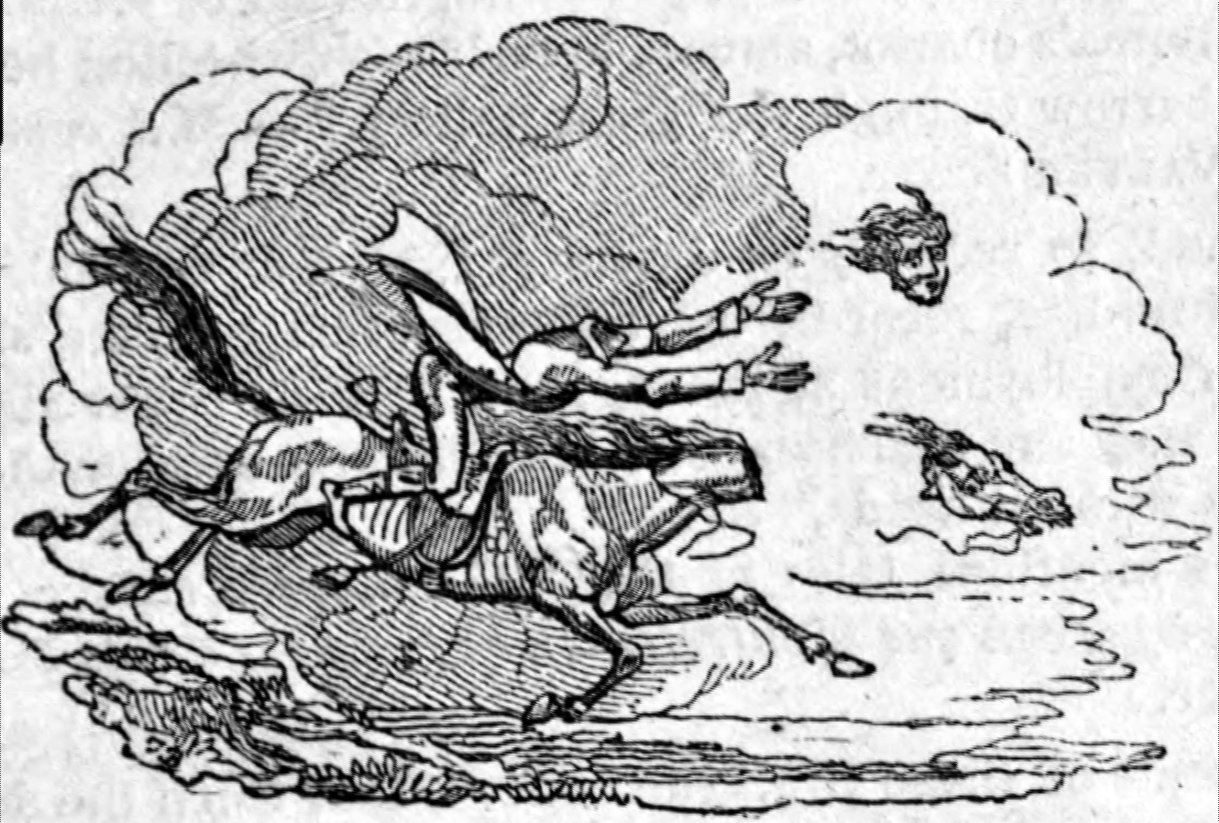
Happy Halloween! As part of my reading of The Legend of Sleepy Hollow this year, I was originally investigating a possible connection between the Headless Horseman and the dullahan, an Irish headless rider I’m familiar with from games like Shin Megami Tensei. Alas – while there certainly seems to be a traceable relationship there, it’s not as direct as I was hoping, and so I decided not to tread farther down that particular avenue for now.

From what I’ve been able to tell, tales of headless horsemen predate the Irish dullahan, and likely stem from German folklore. This makes sense in light of Irving’s Headless Horseman being identified as the specter of a Hessian soldier. One such German tale was a short story by the Brother Grimm, Hans Jagenteufel. It’s a quick and interesting read, and so I thought I’d share. I wasn’t able to find a public domain English translation available online, but ChatGPT was able to translate as follows:
Hans Jagenteufel
Brothers Grimm · Deutsche Sagen (1816) · Translated from German
It is believed that whoever commits a crime deserving of beheading, but whose crime remains undiscovered during his lifetime, must wander after death carrying his head beneath his arm.
In the year 1644, a woman from Dresden went early one Sunday morning into a nearby forest to gather acorns.
While in the heath, near a hollow not far from a place called the Lost Water, she heard the loud blast of a hunting horn. Immediately afterward came a tremendous crash, as though a tree had fallen.
The woman was frightened and hid her little sack of acorns among the bushes.
Soon the horn sounded again, and when she looked around, she saw a headless man riding a dapple-gray horse. He wore a long gray coat, boots, and spurs, and a hunting horn hung across his back.
But as he rode quietly past her, she regained her courage, continued gathering acorns, and returned home that evening without further disturbance.
Nine days later, the woman returned to the same area for the same purpose.
As she sat down on Forester’s Hill to peel an apple, a voice called out from behind her:
“Have you filled your sack with acorns without having them confiscated?”
“No,” she replied. “The foresters are good men and have done me no harm. May God have mercy on me, a sinner!”
With these words, she turned around.
There stood the same gray-coated figure, but this time without his horse. Beneath his arm he carried his head, which had brownish, curly hair.
The woman recoiled in terror, but the specter spoke:
“You do well to ask God for forgiveness of your sins. I was not so fortunate.”
He then told her his story.
One hundred and thirty years earlier, he had lived and had borne the name Hans Jagenteufel, just as his father had.
His father had often warned him not to be too harsh toward poor people, but he had ignored this advice, given himself over to drinking and drunkenness, and committed many wicked deeds.
For this reason, he was now condemned to wander the earth as a damned spirit.

Leave a Reply