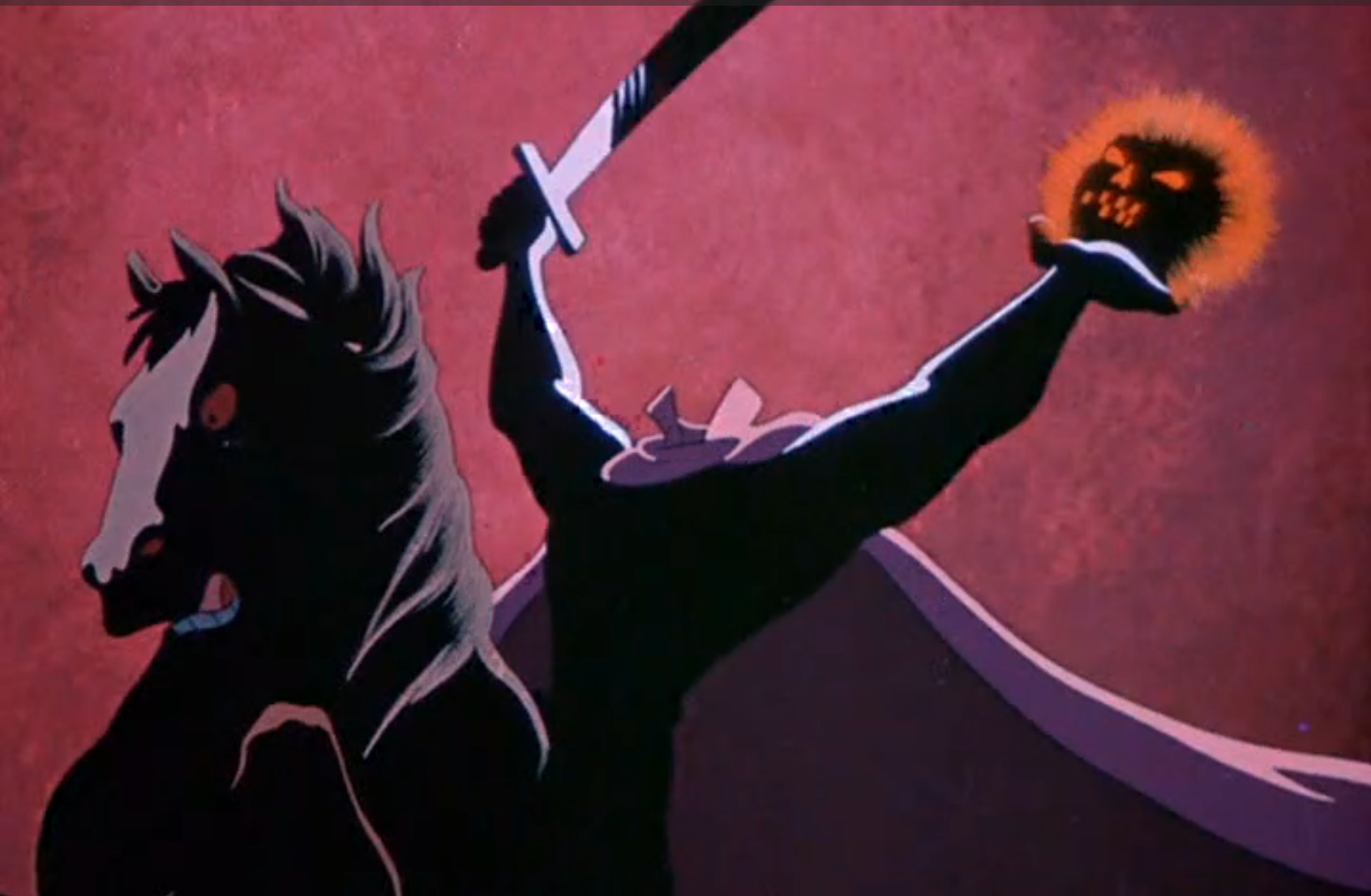
We’re into the spooky season and the start of the months-long stretch of holiday media re-intake. For my part, I like to make my son watch my childhood favorites. Old favorites like the Legend of Sleepy Hollow! This year, with my recently renewed desire to get back to the blog, I decided I’d also give the original Washington Irving story a read to see how the Disney adaptation compares.
The Setup
Although we get a bit of exposition on the Headless Horseman early on in Irving’s narration (more on that later), the introductions to the setting and key characters (Ichabod, Brom Bones, Katrina) are pretty similar. Disney does a good enough job condensing the story and remixing the language in such a way as to weave the story’s original voice with some contemporary tone by cartoon narrator Bing Crosby. Tarrytown and Sleepy Hollow, in both versions, are explained to be a rural community of superstitious folk. Ichabod Crane (what a name!) is presented to be an ambitious schoolmaster of great imagination and appetite. He’s gregarious, plenty superstitious himself, and fond of both food and female company. Katrina is the coquettish daughter of the local farm tycoon, object of every bachelor’s affections. And Brom Bones, Ichabod’s chief rival, is described as the town’s resident quarterback-prom-king: equal parts brute, trickster, and sportsman; the local hero.
Both text and cartoon paint the same picture. Ichabod is eager to curry favor with the townsfolk, but also eager to improve his station. This is all well and good until his misfortune in crossing paths with Katrina and deciding that she (and her inheritance) were to be his.
All these, however, were mere terrors of the night, phantoms of the mind that walk in darkness; and though he had seen many spectres in his time, and been more than once beset by Satan in divers shapes, in his lonely perambulations, yet daylight put an end to all these evils; and he would have passed a pleasant life of it, in despite of the Devil and all his works, if his path had not been crossed by a being that causes more perplexity to mortal man than ghosts, goblins, and the whole race of witches put together, and that was—a woman.
(If as of this reading the above video is no longer available, do yourself a favor and ask your personal hologram to find the Disney Ichabod Crane song for you)
The Storytelling
Although the two forms do diverge in some places (as a written story and a visual adaptable inevitably will), I was pleasantly surprised at how faithful the cartoon adheres to the source material. In part, that could be because of Irving’s particular flavor of prose. In some places, he’s practically describing a cartoon sequence!
The pedagogue’s mouth watered as he looked upon this sumptuous promise of luxurious winter fare. In his devouring mind’s eye, he pictured to himself every roasting-pig running about with a pudding in his belly, and an apple in his mouth; the pigeons were snugly put to bed in a comfortable pie, and tucked in with a coverlet of crust; the geese were swimming in their own gravy; and the ducks pairing cosily in dishes, like snug married couples, with a decent competency of onion sauce. In the porkers he saw carved out the future sleek side of bacon, and juicy relishing ham; not a turkey but he beheld daintily trussed up, with its gizzard under its wing, and, peradventure, a necklace of savory sausages; and even bright chanticleer himself lay sprawling on his back, in a side dish, with uplifted claws, as if craving that quarter which his chivalrous spirit disdained to ask while living.
In describing our protagonist Ichabod Crane’s vivid (and voracious) imaginings of surveyed livestock, Irving is basically writing Meat-O-Vision.

I’d go so far as to say Disney does a masterful job at illustrating Irving’s account of Ichabod, though perhaps not always at the exact same part of the story or in the exact same manner.
Then, as he wended his way by swamp and stream and awful woodland, to the farmhouse where he happened to be quartered, every sound of nature, at that witching hour, fluttered his excited imagination,—the moan of the whip-poor-will from the hillside, the boding cry of the tree toad, that harbinger of storm, the dreary hooting of the screech owl, or the sudden rustling in the thicket of birds frightened from their roost. The fireflies, too, which sparkled most vividly in the darkest places, now and then startled him, as one of uncommon brightness would stream across his path; and if, by chance, a huge blockhead of a beetle came winging his blundering flight against him, the poor varlet was ready to give up the ghost, with the idea that he was struck with a witch’s token.

The Headless Horseman & Ichabod’s Fate
I recently related on social media that growing up, I never really made the connection between Brom Bones and the Headless Horseman, or at least I never gave it much thought beyond the surface narration. It’s quite interesting, though, that both versions of Sleepy Hollow have their own spin on this that ultimately land in much the same place.
It’s worth noting that while the cartoon doesn’t bring out the Horseman until well near the conclusion of the story, Irving introduces him almost straightaway:
The dominant spirit, however, that haunts this enchanted region, and seems to be commander-in-chief of all the powers of the air, is the apparition of a figure on horseback, without a head. It is said by some to be the ghost of a Hessian trooper, whose head had been carried away by a cannon-ball, in some nameless battle during the Revolutionary War[…]
In the text, in the late hours of the night at the Van Tassels’ party, guests first exchange war stories, then tales of of ghosts and apparitions. One old man tells of an encounter with the Headless Horseman, in which the specter had transformed and thrown him into the brook under the bridge. Brom then upstages this story with one of his own, relating a race with the Horseman that he had won, prompting the ghost to flee into the night.
In the the Disney version, at the same party, Brom notices Ichabod’s superstitious nature and tells the tale of the Headless Horseman specifically to frighten the spindly teacher.

Now both stories heavily imply that the Horseman Ichabod encounters on his ride home are, in fact, Brom Bones. They do so, however, in different ways. The Disney cartoon presents a number of visual clues – the similarities between Brom’s and the Horseman’s mounts, the resemblance of their swords, and foreshadowing of Brom throwing a jack-o-lantern into the fireplace at the party.


The only visual that actually gave me pause in my assessment here was the chase scene. At one point, Ichabod collides with the Horseman and peers straight down into his collar. If Brom were inside, you’d think that would have become apparent.
In the book, on the other hand, Ichabod isn’t immediately pursued and attacked by the Horseman. Rather, the specter rides up along side him and silently keeps pace. When Ichabod speeds up, he speeds up. This matches Brom’s earlier tale of a midnight race. It also matches the description of Brom as more mischievous than malicious. If the Horseman were Brom, it’s in closer fitting with his character that he’d be trying to scare Ichabod rather than kill him. At the end of the ride, at the bridge, the Horseman is said to throw his head and hit the schoolteacher right in the noggin.
The more obvious implication is delivered to us just a little later in the text:
Brom Bones, too, who, shortly after his rival’s disappearance conducted the blooming Katrina in triumph to the altar, was observed to look exceedingly knowing whenever the story of Ichabod was related, and always burst into a hearty laugh at the mention of the pumpkin; which led some to suspect that he knew more about the matter than he chose to tell.
The other notable difference in the ending events of the two versions is how Katrina relates to Ichabod’s fate. In the Disney cartoon, Ichabod’s disappearance seems to drive Katrina to Brom by default. With his main competition gone, the jock-king wins. All according to plan! Eat that, nerd. Rumors do eventually reach Sleepy Hollow that Ichabod was seen alive in a distant county, married to a wealthy widow.
In the book, Ichabod leaves the Van Tassel party crestfallen after an undetailed conversation with Katrina. We are left to infer that she dismissed the suitor in favor of Brom Bones, whom she also marries in this version of the story. After his ill-fated ride home, a smashed pumpkin is found at the bridge, and rumors later reach the village that he moved far away and became a lawyer, politician, and then judge.
In both versions, many of the folk of Sleepy Hollow refuse to believe the rumors, instead choosing to belief Ichabod to have been spirited away by their local goblin.
American Myth
Growing up in New York, some of the geographic features and the setting for the story were somewhat familiar to me – the Hudson and the Tappan Zee, specifically. I never really thought about it before, but this extra little sense of familiarity is usually unavailable to those of us over here in the New World. We’ve got smatterings of legend and folk tale – Paul Bunyan, Pecos Bill, Johnny Appleseed, but we’ve got nowhere near the lengthy tradition of places like Japan, Great Britain, or Scandinavia. Not at to say that one can’t full-heartedly enjoy the tales of Otherland; I’m just glad to be expanding my consciousness of the American canon.

Leave a Reply